Dashboard v2 API
Dashboard v2 is the typed project workspace contract used by the local
dashboard. The primary hierarchy is Project -> Outcomes -> Initiatives ->
Tasks -> Evidence. Existing snapshot, graph, map, terminal, and action routes
remain available for compatibility.
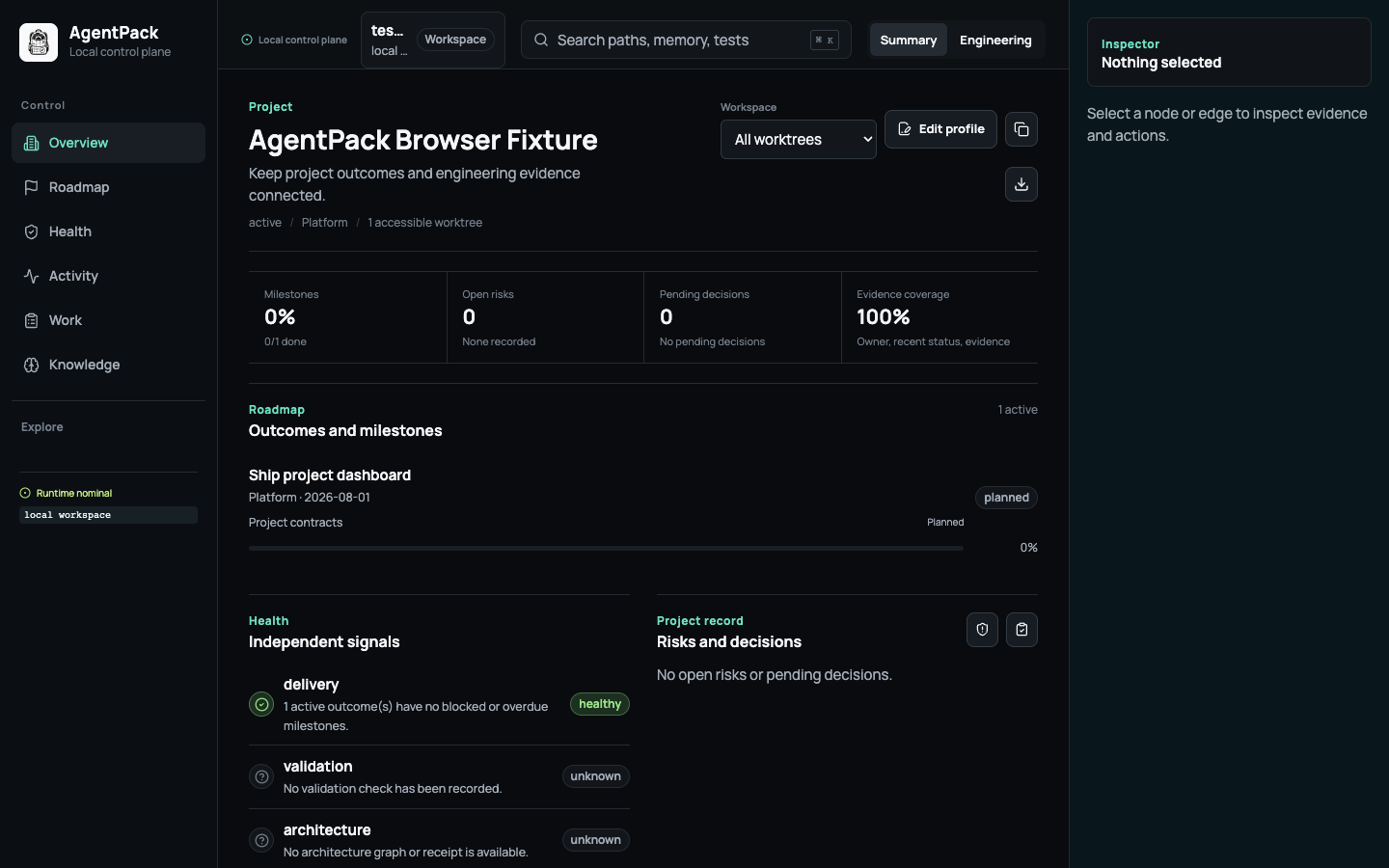
The stable primary views are Overview, Roadmap, Work, Health, and Knowledge. Activity remains available from Overview and the command palette. Repository, operations, connection, and diagnostic tools are grouped under Explore so the project decision remains the first surface.
The canonical response schema is
docs/schemas/dashboard-v2.schema.json.
The server validates its payloads through the Python models in
src/agentpack/dashboard/contracts.py; clients should treat unknown optional
fields as forward-compatible.
Engineering Atlas portfolio is exposed at GET /api/dashboard/v2/portfolio.
It reads global index rows and bounded local status caches, groups linked
worktrees by canonical project identity, and returns bounded project,
relation, attention, and activity collections. Use POST
/api/dashboard/v2/portfolio/github/refresh for explicit read-only GitHub
evidence refresh. Normal portfolio reads do not invoke GitHub.
Workspace experience

Endpoints
All endpoints are loopback-only by default and require the dashboard token in
X-AgentPack-Token.
| Method | Path | Purpose |
|---|---|---|
GET |
/api/dashboard/v2?detail=home\|full |
Workspace envelope, task, graph/map data, agent state, and impact summary |
GET |
/api/dashboard/v2/portfolio |
Local-first Engineering Atlas portfolio envelope |
POST |
/api/dashboard/v2/portfolio/github/refresh |
Explicit bounded GitHub evidence refresh |
GET |
/api/dashboard/v2/impact?query=&relationship=&language=&confidence=&limit=200 |
Bounded Tree-sitter impact entities, relationships, evidence, and affected tests |
GET |
/api/dashboard/v2/evidence |
Context, selected files, task map, observer, and timeline evidence |
GET |
/api/dashboard/v2/actions |
Suggested actions and the typed action catalog |
POST |
/api/dashboard/v2/actions/inspect |
Explain an action before execution |
POST |
/api/dashboard/v2/actions/run |
Run an approved action through the existing PTY runner |
GET |
/api/dashboard/v2/agents |
Public handoffs and detected agent sessions |
GET |
/api/learning/profile |
Private global learner role and target level |
POST |
/api/learning/profile |
Authenticated learner profile update with a mutation ID |
GET |
/api/learning/recommendations?scope=local\|global |
Read-only schema-v2 queue, profile, and seven competency summaries; dashboard reads do not record recommendation impressions |
POST |
/api/learning/sessions/start |
Start a project-owned session and return its question, evidence, and host coaching prompt |
POST |
/api/learning/sessions/complete |
Validate and record structured host-evaluated proof; canonical retries are idempotent |
GET |
/api/project/overview?workspace=all\|current\|ID |
Profile, roadmap, initiatives, risks, decisions, health, metrics, worktrees, and recent changes |
GET |
/api/project/timeline?workspace=...&kind=...&limit=50 |
Unified project activity; limit is capped at 200 |
GET |
/api/project/brief?mode=summary\|engineering |
Deterministic redacted Markdown; no repository file is written |
POST |
/api/project/profile |
Revisioned, idempotent shared profile and roadmap update |
POST |
/api/project/events |
Idempotent local outcome, milestone, risk, decision, or initiative event |
POST |
/api/dashboard/v2/agents/resume |
Resume a named handoff |
POST |
/api/dashboard/v2/agents/release |
Release a claimed handoff |
Project contract
The selected worktree's .agentpack/config.toml is authoritative for shared
profile, outcome, and milestone definitions. Project reads discover up to 20
worktrees through Git's common directory and aggregate bounded local artifacts.
Malformed or inaccessible worktrees are skipped with warnings and
partial=true; AgentPack never scans unrelated source trees.
Every derived project record carries source, confidence, updated_at,
bounded evidence, workspace_id, and warnings. Missing validation,
architecture, release, context, or knowledge evidence remains unknown.
Delivery progress comes only from declared milestones.
The Knowledge view uses the same learning service as CLI and MCP. It shows the
global role/level profile, all seven competencies, the now, weak_spot, and
breadth queue, and an active session. Start and completion reject unregistered,
inaccessible, or read-only owning projects before appending a session row. The
browser refreshes recommendation and competency state when focus returns after
host-agent coaching.
Profile writes require both a unique mutation_id and the current 64-character
expected_revision. The revision is the SHA-256 hash of the config contents.
Duplicate mutation retries return their prior result; stale revisions return
409 without changing the file. Dynamic project state is appended as
project_* rows in the existing session-event log and folded at read time.
The Overview, Roadmap, Health, and Activity views support all, current, or a
specific workspace ID. Mutating operations remain scoped to the current
worktree. Summary and Engineering briefs are capped at 20 KB and run through
the existing redactor. Summary omits absolute paths and raw commands;
Engineering may include relative paths, branches, SHAs, and check details.
Action inspection
Inspection uses the same action builder and terminal policy as v1. The response is deliberately explicit so a UI or agent can show the intended effect before running it:
{
  "inspection": {
    "schema_version": 2,
    "action": "refresh_context",
    "command": "agentpack guard --agent codex --refresh-context --thread global",
    "cwd": "/workspace/project",
    "purpose": "Refresh the task-scoped context.",
    "risk": "low",
    "risk_reasons": [],
    "affected_paths": ["src/auth.py"],
    "expected_effect": "Refresh the task-scoped context and update selected-file evidence.",
    "confirm_required": false,
    "allowed": true
  }
}
Medium and high-risk actions must be confirmed by the caller. Execution remains available through the existing terminal and MCP paths; v2 does not create a second command runner.
Action requests reject unknown fields and require a non-empty action. The
same request contract is used for inspection and execution:
{
  "action": "dev_check",
  "target": "src/auth.py",
  "confirmed": false
}
Successful execution returns schema_version, the terminal session, and the
exact command. Resume and release accept only a memorable handoff name:
{ "name": "auth-session-retry" }
The agents response contains detected provider sessions, active AgentPack threads, integration health, and public handoff fields. Internal handoff UUIDs are never included.
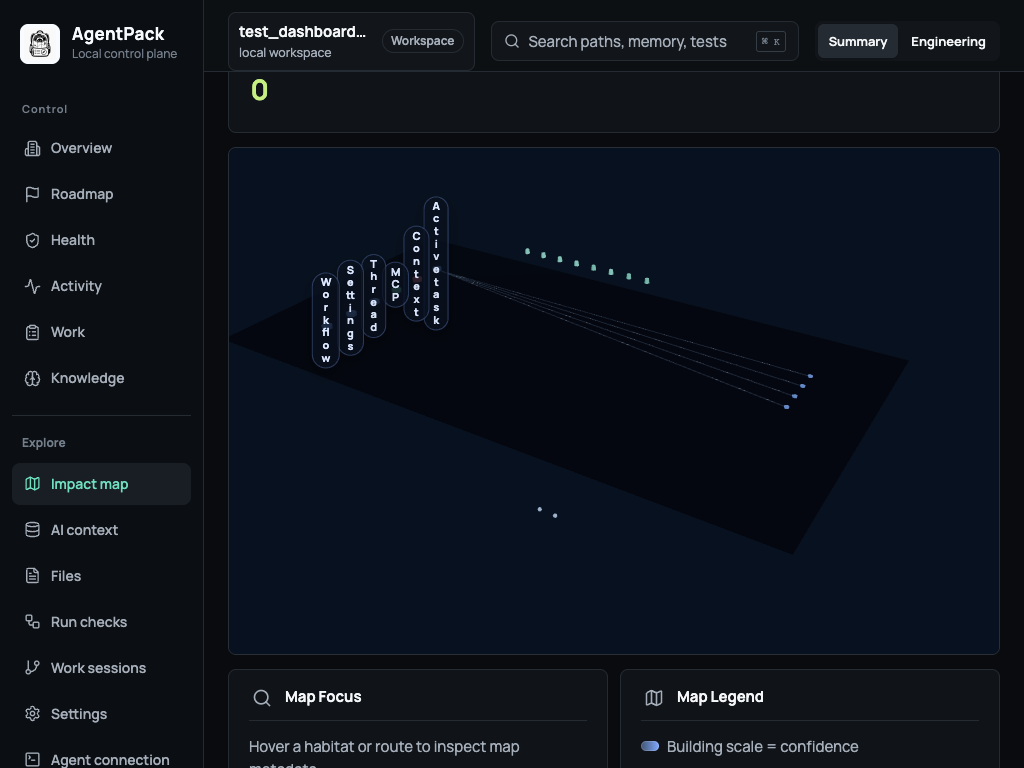
Impact scene
/impact returns the existing summary plus stable entities,
relationships, affected_tests, and scene fields. Entity IDs use
file:<path>, semantic:<entity-key>, and action:<action-id>; relationship
IDs use relationship:<edge-key>. The same identifiers drive 3D, semantic
graph, table, and inspector selection. scene.available=false includes an
unavailable_reason, and clients retain loaded workspace data and use the
table fallback.
Errors and unavailable states
All v2 failures use the errorResponse schema with schema_version, error,
stable kind, retryable, and optional detail fields.
| Status | Meaning | Common kinds |
|---|---|---|
400 |
Malformed JSON, unknown fields, missing values, or invalid action | malformed_json, invalid_request, invalid_action |
401 |
Missing or invalid dashboard token | unauthorized |
403 |
Read-only project, provider/session restriction, or denied operation | permission_denied |
409 |
Config revision, confirmation, claim, stale-state, or repository conflict | config_conflict, action_conflict, handoff_conflict, stale_handoff, repository_mismatch |
500 |
Unexpected local server failure | server_error |
Tree-sitter, MCP, and scene availability are represented inside successful responses so the workspace remains usable. The shared state surface maps stale context, unavailable capabilities, permission failures, repository mismatch, conflict, WebGL fallback, and retryable server errors to a concrete recovery action without clearing previously loaded data.
Compatibility and migration
Existing /api/dashboard, /api/graph, /api/map, /api/action/run, and
terminal endpoints are unchanged. Migrate consumers incrementally by reading
the v2 workspace envelope first, then using /impact for symbol-level
navigation and /actions/inspect before /actions/run. The dashboard stores
the global Summary/Engineering preference locally as
agentpack.dashboard.presentation_mode. Stored values remain explain or
build for compatibility.
The top-bar search control opens a keyboard command palette with Cmd+K or
Ctrl+K. It indexes loaded project evidence immediately and requests bounded
repository evidence lazily. Palette actions are fixed, parameterless AgentPack
actions and always pass through the existing inspection and confirmation flow.
Queries, task text, command strings, and result content are never persisted;
only eight result IDs per project may be stored as recents.
The home payload includes independent API, snapshot, Context, and MCP evidence
instead of a composite runtime claim. It may also include
cached_project_status, a server-produced, secret-redacted project summary
that excludes absolute paths, task and memory content, commands, graphs,
terminal history, and action history. The browser retains one compatible
snapshot for up to seven days. Last-known mode is read-only: navigation and
cached project-evidence search remain available, while mutations, checks,
actions, brief generation, and project switching are disabled.
When Tree-sitter, MCP, WebGL, or an optional artifact is unavailable, v2 keeps the already-loaded envelope and reports an unavailable or stale state. Clients should offer the 2D graph/table fallback and a retry or terminal action instead of treating the condition as an empty repository.
TypeScript consumers import generated definitions from
frontend/dashboard/src/data/dashboard-v2.generated.ts. Run
npm run generate:contracts after changing the schema and
npm run check:contracts in CI to reject drift.